 Mowo
Rendering
How Mowo draws a frame. A deferred renderer on one RHI with four backends, real-time Global Illumination and five quality tiers.
Mowo renders every scene through one deferred renderer, SceneRenderer. It records its passes through an abstract RHI, so the same frame runs on each backend: D3D11RHI, D3D12RHI, MetalRHI, VulkanRHI. A quality tier decides which features run, and every feature has a console variable that can override the tier.
This section explains how a frame is built, how to choose a backend and a tier, and how lights, shadows, Global Illumination, ray tracing, upscaling, materials and post-processing fit together.
The layers
Rendering code is split into layers. You mostly work with the top one.
| Layer | Module | What it owns |
|---|---|---|
| Scene components | SceneTypes, Game | Lights, sky, reflection captures, mesh, splat and volume components and their actors |
| Scene renderer | SceneRenderer | The deferred pipeline, Global Illumination, shadows, post-processing, quality tiers () |
| Renderer data | Renderer | Materials, meshes, light structs and per-frame data (RenderFrameData, ScenePostProcess) |
| RHI | RHI plus D3D12RHI, VulkanRHI, MetalRHI, D3D11RHI | The abstract GPU API, the render graph, upscaler and frame-generation interfaces. The RHI module holds no backend code. |
Each backend registers a factory when its module loads, and the abstract Create() calls dispatch through it. Capability gating has two axes: says what an API can ever do, and the live RendererCapabilities say what this device can do now. The editor hides a control the API can never support and greys one the device lacks.
How a frame is drawn, in short
Opaque geometry writes a G-Buffer first, and lighting runs once per pixel over it. Translucent surfaces are drawn forward afterward, and post-processing finishes the frame.
- Shadows
- G-Buffer
- Velocity
- AO
- Lighting
- GI
- Sky
- Reflections
- Fog
- Translucency
- Post
- Upscale
- Tonemap
- Overlays
Read Frame pipeline for every stage in order.
What you get at each tier
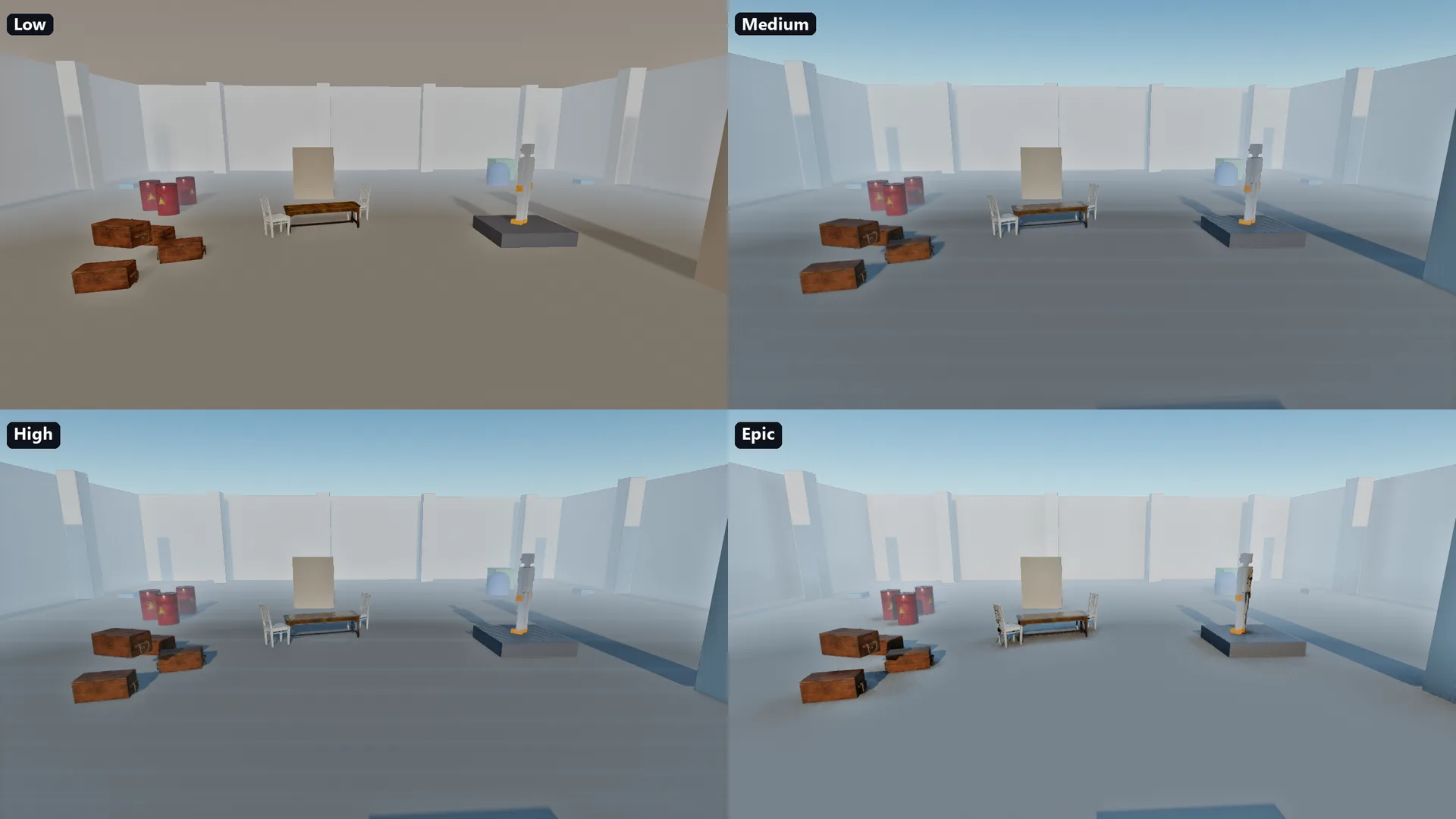
There are five tiers: Low, Medium, High, Epic and Cinematic (). High is the code default; when you do not pick one, the engine picks a tier for the machine at launch.
| Tier | What it adds |
|---|---|
| Low | Clustered lighting, 2-cascade sun shadows, 0.75 render scale. No live Global Illumination (a baked field if present), no SSR, no GTAO. |
| Medium | Global Illumination with world probes, SSR, GTAO, bloom, motion blur, subsurface scattering, SDF far sun shadows. |
| High | The screen-probe gather, 4 cascades, soft shadows, a depth prepass, translucent reflections, the terrain virtual texture. |
| Epic | Virtual shadow maps for sun and local lights, MegaLights, ray-traced reflections and AO, the ray-traced GI gather, volumetric fog and clouds, the meshlet G-Buffer. |
| Cinematic | Ray-traced sun shadows, larger budgets everywhere, no small-object or occlusion culling, native resolution. |
The rows come from. Ray-traced features need a GPU and backend with ray query; without one they fall back to their raster or screen-space versions each frame.
The editor viewport always renders at native resolution with a temporal AA resolve, whatever the tier's upscaler says, so you never judge reconstructed pixels. The shipped game keeps the tier's upscaling.
Backends at a glance
| Platform | Default | Also available |
|---|---|---|
| Windows x64 | Direct3D 12 | Vulkan (selectable), Direct3D 11 (automatic fallback only) |
| macOS on Apple silicon | Metal | None |
| Linux x64 | Vulkan In development | None |
See Backends for how to switch and what each API supports.
Pages in this section
API reference
- SceneRenderer module:
SceneRenderer,EQualityPreset,FQualityAutoTier,FRenderPassExtensions - Renderer module:
Material,ScenePostProcess,RenderFrameData - Volumes module:
VolumeManager,VolumeProfile - Console variables
Engine sources
This page describes behavior implemented in these files of the engine repository, checked against commit 5922e6e5e.
- Engine/Source/Runtime/SceneRenderer/Public/Renderer/SceneRenderer.h
- Engine/Source/Runtime/RHI/Public/RHI/RendererAPI.h
- Engine/Source/Runtime/RHI/Public/RHI/RHIFactory.h
- Engine/Source/Runtime/Renderer/Public/Renderer/RenderFrameData.h