 Mowo
Redirectors
How Mowo keeps references working when you rename an asset, a reflected field, a type or an enum value, and how Fix Up Redirectors retires them.
Renaming things breaks references unless something remembers the old name. Mowo has two kinds of redirect for this, and both live in one committed file, Config/Redirects.ini, in the [CoreRedirects] section Unreal developers know:
- Asset redirects keep an old asset path resolving after you rename or move the asset.
- Field, type and enum redirects keep old data loading after you rename a reflected property, a class or struct, or an enum value in C++.
Why asset paths need redirects
References through the asset registry use ids, and an id survives a rename because it lives in the asset's package summary or sidecar. But many references store a path string, such as a mesh component's model path, and that string is written verbatim into .mmap, .actor and .prefab files. A rename would leave every one of those pointing at nothing.
A redirect records where the asset went, so the old path keeps resolving until the files that name it are rewritten.
- Rename in the Content Browser
- AddRedirect(old, new)
- Config/Redirects.ini
- Old paths still resolve
- Fix Up Redirectors
What creates a redirect
Renaming or moving an asset in the Content Browser calls AssetRegistry::AddRedirect(old, new). So does Reimport With New File… when the new file has a different extension. Opening an older project adds one for every file it renames to its new extension, and mbt asset migrate --source-art adds one from each moved source to its package (see File types).
Redirects behave predictably:
- Chains collapse. After A→B and then B→C, A resolves straight to C.
- Round trips cancel. Renaming A to B and back to A drops the redirect instead of storing A→A.
- They are saved at once. Each change is written to
Config/Redirects.inistraight away, so a crash after a rename does not lose it. A folder rename that records one redirect per file writes the file once, at the end.
The editor, the cook and the packaged game all read the file. A packaged game loads Config/Redirects.ini from its game root and logs how many field, type and path redirects it read. The dependency-driven cook also passes it to the dependency collector, so a scene that still names an old path cooks the right file.
Fix up redirectors
A redirect is meant to be temporary. Fix Up Redirectors rewrites every file that still names an old path, then retires the redirects nothing references any more.
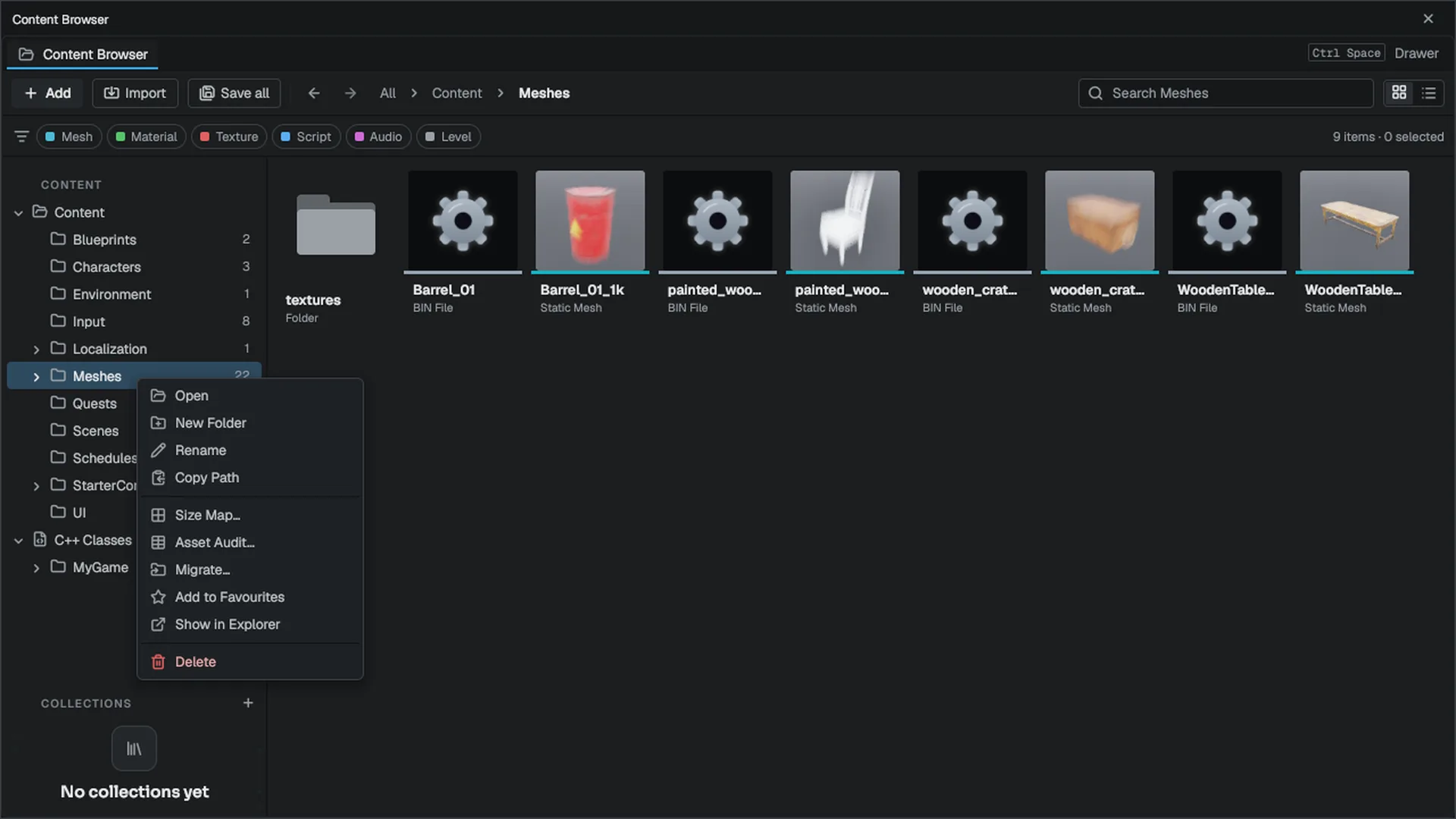
- Open the folder menu
In the Content Browser, right-click a folder. Fix Up Redirectors is enabled when the project has at least one outstanding redirect.
- Run it
Choose Fix Up Redirectors. The pass scans the project's content tree and rewrites references in place.
- Read the result
A notification reports how many references it rewrote, in how many files, and how many redirects it retired. If it kept any, the notification is a warning and names up to three files it could not rewrite.
- Commit
Commit the rewritten assets together with the updated
Config/Redirects.ini.
The rewrite is textual and anchored on the surrounding quotes. Only a complete quoted value can match, never part of a longer path, and the file's formatting and comments stay untouched. Which files are rewritable is decided by looking at their bytes, not their extension, so new MDF asset types are covered automatically. A redirect is retired only after every file that could name it was examined. When a file cannot be rewritten, its redirects are kept.
Field and type redirects
Renaming a reflected property in C++ would otherwise lose data. The stored key no longer matches any property, so the loader drops the value and only logs it at debug level. Renaming a component type is worse: the whole node is skipped with a warning.
FFieldRedirects tells the loader where the value went. When the reflection serializer cannot find a property under its current name, it asks for the old spelling and reads that instead.
Declare redirects in Config/Redirects.ini
A game declares its own renames without code:
[CoreRedirects]
+PropertyRedirects=(OldName="LightComponent.colour",NewName="LightComponent.color")
+ClassRedirects=(OldName="PointLight",NewName="LightComponent")
+StructRedirects=(OldName="FOldStats",NewName="FStats")
+EnumRedirects=(OldName="LightType",ValueChanges=(("Omni","Point"),("Sun","Directional")))
+PackageRedirects=(OldName="Content/Old.tex",NewName="Content/New.tex")
The editor writes the +PackageRedirects lines for asset renames and leaves your other lines and their comments as they were. When no entries are left, the editor removes the file instead of committing an empty one.
The editor loads the file when a project opens, the cook passes it to the dependency collector, and the packaged game reads it at startup. A missing file is not an error. An older project's Config/Redirects.mdf is still read and is converted to the INI the first time the editor writes to it.
Register redirects in code
Engine renames belong next to the code that caused them. Register them at startup:
#include "Reflection/FieldRedirects.h"

Mowo::FFieldRedirects::RegisterProperty("LightComponent", "colour", "color");
Mowo::FFieldRedirects::RegisterType("PointLight", "LightComponent");
Mowo::FFieldRedirects::RegisterEnumValue("LightType", "Omni", "Point");
Property chains are followed on lookup, so a field renamed twice still finds its oldest spelling.
Add the redirect in the same change as the rename. A redirect handles a new name. It does not convert units or split one field into two.
Related
- Sidecars and UUIDs explains the references that do not need redirects.
- API: AssetRegistry, FAssetRedirectFixup, FFieldRedirects.
Engine sources
This page describes behavior implemented in these files of the engine repository, checked against commit 5922e6e5e.
- Engine/Source/Runtime/AssetSystem/Public/AssetSystem/AssetRegistry.h
- Engine/Source/Runtime/AssetSystem/Public/AssetSystem/AssetRedirectFixup.h
- Engine/Source/Runtime/Reflection/Public/Reflection/FieldRedirects.h