 Mowo
Replication
How networked objects, replicated component fields, relevancy and per-client budgets keep every client's copy of the world in step with the host.
Replication is how the host keeps each client's copy of the world in sync. Every networked entity has an authoritative version on the host and a ghost on each client. The host sends only the fields that changed, and the client applies them to its ghost. Which fields travel is decided by reflection: you mark a field, and it replicates.
Networked objects
An entity joins replication by carrying a NetworkObjectComponent NetworkObjectComponent. It is a reflected component in the Networking category, so it saves into scenes and prefabs and you can add it from the Details panel with no code.
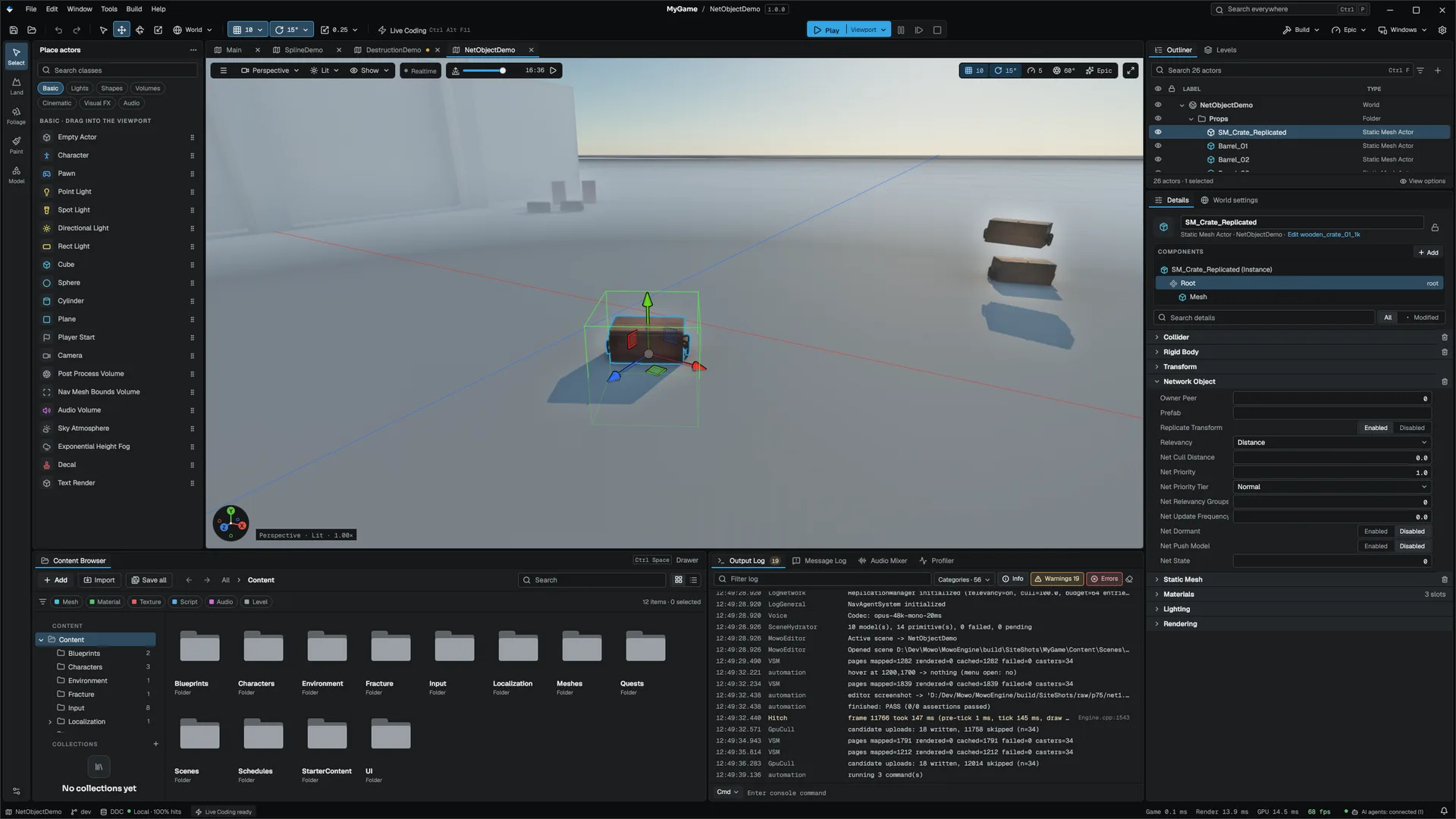
| Field | Default | Meaning |
|---|---|---|
networkId | assigned at spawn | Session-local id the host assigns. Runtime only. |
ownerPeerId | 0 | Peer that owns and drives the object. 0 is the host. An object is always relevant to its owner. |
prefabPath | empty | Prefab the client instantiates for the ghost. Empty spawns a bare transform ghost. |
replicateTransform | true | Whether the transform replicates. Other replicated components are unaffected. |
relevancy | Distance | Distance, Always or Never (host only). |
netCullDistance | 0 | Relevancy radius. 0 or less falls back to net.cull_distance. |
netPriority | 1.0 | Send-order weight when the budget is tight. |
netPriorityTier | Normal | Critical, High, Normal or Low. |
netRelevancyGroups | 0 | Bitmask of relevancy groups. 0 means no restriction. |
netUpdateFrequency | 0 | How many times a second the object's continuous state is considered. 0 or less means every snapshot tick. |
netDormant | false | A dormant object's continuous state is neither diffed nor sent until it wakes. |
netPushModel | false | The object promises to mark itself dirty after every change. |
netState | 0 | A replicated 32-bit word for small discrete state. Ships reliably. |
Scene-placed networked objects also carry a hidden placedGuid, stamped when the scene is saved. Both peers load the same scene, so when the host's spawn message arrives the client adopts the local entity with the same id instead of creating a duplicate.
Replicate a component field
Mark a field of any reflected component with MREPLICATED. There is no engine list to extend: every reflected component with at least one replicated field joins replication automatically, and per object the set is whatever components that entity carries.
#pragma once

#include "Core/Platform.h"
#include "ECS/Component.h"
#include "Math/Vec3.h"
#include "Reflection/Reflect.h"

#include <cstdint>

namespace Mowo {

struct MOWO_REFLECTED_NAMED("Turret") MCATEGORY("Gameplay") TurretComponent {
	MOWO_COMPONENT(TurretComponent)

	MOWO_KEY("aim") MOWO_DISPLAY("Aim Direction")
	MREPLICATED MNET_QUANTIZE(Normal) Vec3 aimDirection = Vec3(0.0f, 0.0f, 1.0f);

	MOWO_KEY("ammo") MOWO_DISPLAY("Ammo")
	MREPLICATED_USING(OnRep_Ammo) MNET_CONDITION(OwnerOnly) uint32_t ammo = 30;

	MOWO_RUNTIME_ONLY bool lowAmmoWarning = false;

	void OnRep_Ammo() {
		lowAmmoWarning = ammo < 5;
	}
};

}
MREPLICATED_USING(fn) implies MREPLICATED and names a member function the receiving side calls when an update actually changes the field's value. A resend of identical bytes does not call it again.
Continuous and discrete fields
The host splits each object's changed fields in two:
| Kind | Types | Channel | Why |
|---|---|---|---|
| Continuous | float, Vec2, Vec3, Vec4, Quat | Unreliable Snapshot | The next update overwrites a lost one while the object keeps moving. |
| Discrete | Everything else (bool, integers, enums, UUIDs, strings, arrays, structs) | Reliable StateSnapshot | A lost update must never leave a client on a stale value. |
A component with both kinds of field appears on both streams, with an independent baseline on each.
Which types may replicate
Every field is written by value through a per-type codec:
- Fixed-width types:
Bool,Int,UInt8,UInt32,Float,Vec2,Vec3,Vec4,Quat,UUIDandEnum. - Strings, by value with a length prefix.
MSTRUCTvalues, member by member, when every member has a codec.- Arrays of fixed-width elements, count-prefixed. An array is resent whole when any element changes; use a fast array for lists that change one item at a time.
Asset references, custom types, maps and sets are refused. A struct with a member that has no codec refuses the whole struct rather than silently skipping a member. For anything else, replicate a fixed-width handle such as an id or an enum and resolve it locally.
Quantization
MNET_QUANTIZE(q) narrows a float, vector or quaternion on the wire PropertyInfo:
| Quantizer | Encoding |
|---|---|
Whole, Deci, Centi, Milli | Fixed point at 1, 0.1, 0.01 or 0.001 of the stored unit. A value that is not finite or does not fit after scaling falls back to raw floats. |
Normal | 16 bits per component in [-1, 1]. |
Angle | 16 bits per radian component, wrapped to one turn. |
SmallestThree | A unit quaternion in three 15-bit components plus a 2-bit index. |
Change detection compares the quantized encodings, so jitter below the quantum costs nothing. TransformComponent position and rotation ship as Milli.
Conditions
MNET_CONDITION(c) limits a field to some of the peers the object is relevant to:
| Condition | Reaches |
|---|---|
OwnerOnly | Only the peer in ownerPeerId. |
SkipOwner | Every relevant peer except the owner. |
InitialOnly | Each peer once, when the component is first sent to it (spawn or becoming relevant). |
InitialOrOwner | The owner always, everyone else once. |
A field a peer may not see is left out of its delta, never zeroed, so a non-owner keeps the spawn default of an owner-only field. An object owned by the host (ownerPeerId == 0) has no owning client, so its OwnerOnly fields reach nobody.
Owner-only fields follow ownership. The host checks every networked object's ownerPeerId once per snapshot tick. When it changed, every client is told the new owner, and the old and the new owner both have their baselines for that object reset and get its discrete state in full ReplicationManager::ServerDetectOwnerChanges. You only need ServerResyncPeer to resend a whole peer's world.
Both machines must run the same build. The replication header carries a protocol version and a schema id computed from every replicated type, field, quantizer and condition. A peer on a different build is refused at the header and the client fails with ProtocolMismatch, so adding or changing a replicated field means shipping the new binary to everyone.
Script actors
An actor written in Wolang replicates through attributes instead of MREPLICATED: @Replicated on a field, @Server, @Client and @Multicast on a method. A script object lives in the Wolang heap and its fields change with a hot reload, so it does not take the component path above. The host packs the fields that changed into one batch per actor and sends it on the script actor lane, a reserved RPC method id that clients can only use for an actor they own.
| Wolang | Engine |
|---|---|
@Replicated | Server to every client, reliable, when the value changes |
@Replicated(owner) | MNET_CONDITION(OwnerOnly): the owning client only |
There are no per-client baselines: a joining peer makes the host send every field again, and a new owner gets the owner-only fields. InitialOnly and SkipOwner have no attribute spelling yet. A client that writes a replicated field from its script is put back to the server's value. See Wolang scripting for the attributes, the value types and the limits.
Object references
A field that points at another networked object holds its NetworkId. The id can reach a client before the object it names (a reliable delta overtaking a spawn, or an object not yet relevant), so resolve it with WhenNetworkIdResolves(nid, fn) ReplicationManager::WhenNetworkIdResolves. The callback runs at once when the id is already mapped, otherwise when the spawn that maps it arrives. FindEntityByNetworkId is the synchronous lookup.
Fast arrays
TNetFastArray<TItem> TNetFastArray replicates a list item by item: only added, changed and removed items travel, on the reliable channel, and the receiver gets per-item callbacks. Use it for inventories, active effects and other lists that change one entry at a time.
#include "Networking/Replication/NetFastArray.h"
#include "Networking/Replication/ReplicationManager.h"

struct FInventorySlot : Mowo::FNetFastArrayItem {
	uint32_t ItemId = 0;
	int32_t Count = 0;

	void NetSerialize(Mowo::FNetBitWriter& w) const {
		w.WritePackedUInt(ItemId);
		w.WritePackedInt(Count);
	}

	bool NetDeserialize(Mowo::FNetBitReader& r) {
		ItemId = r.ReadPackedUInt();
		Count = r.ReadPackedInt();
		return !r.IsOverflowed();
	}
};

static Mowo::TNetFastArray<FInventorySlot> sm_Inventory;

static void BindInventory(Mowo::ReplicationManager& replication, uint64_t pawnEntity) {
	replication.RegisterFastArray(pawnEntity, 1, &sm_Inventory, true);
}

static void UseItem(size_t index) {
	FInventorySlot& slot = sm_Inventory.Items[index];
	slot.Count -= 1;
	sm_Inventory.MarkItemDirty(slot);

	sm_Inventory.RemoveItems([](const FInventorySlot& s) { return s.Count <= 0; });
}
On the host, AddItem adds and marks an item, MarkItemDirty marks an item you changed in place, and RemoveItems (or an erase from Items followed by MarkArrayDirty) removes. The client binds the same entity and array id; OnAdded, OnChanged and OnRemoving run on the receiver only. The last argument of RegisterFastArray limits the list to the owning peer.
What the wire carries
The replication protocol is version 9 ReplicationPacketType. The host sends:
- Spawn when an object becomes known to a client: network id, owner, full pose,
netState, prefab path and placed-object id. - Destroy when an object is removed or leaves a client's relevancy.
- Snapshot with continuous field deltas, on the unreliable channel.
- StateSnapshot with discrete field deltas, on the reliable channel.
- FastArrayDelta with fast-array changes, on the reliable channel after the snapshot.
- OwnerChange when an object's owner changes, on the reliable channel.
- SpatialData with keyed deltas for the spatial stream, acknowledged by the client with SpatialAck; a client sends SpatialInterest to declare what it wants.
Positions travel in absolute world space, so a client or host that has rebased its origin still agrees with the other side; see Large worlds.
Clients send input, RPCs and acknowledgements. Either side sends Blob and BlobAck packets, which carry a large RPC in chunks (see RPCs and events). The host drops any spawn, destroy, snapshot or owner change that arrives from a client, so a client cannot create entities, overwrite replicated state or take ownership.
Acknowledged baselines
Continuous deltas are built per client against the last state that client acknowledged, not the last state the host sent:
- The host sends a snapshotEach snapshot carries a per-client packet id. The new state is recorded as pending against that id.
- The client acknowledgesThe client sends back the highest snapshot id it received.
- The baseline advancesPending state at or below the acknowledged id becomes the new baseline. Until then, the host keeps diffing against the old one, so a dropped snapshot is repaired on the next send.
A client that stops acknowledging for net.max_unacked_sends snapshots is treated as stalled. The host then sends it only an empty probe every net.ack_probe_interval ticks, and resynchronizes it when it recovers.
Doing less work per object
Three per-object switches cut the host's diffing cost:
- Update frequency.
netUpdateFrequency(Hz) makes a slow object be considered only that often. A 5 Hz prop under a 20 Hz snapshot rate is diffed every fourth tick. - Dormancy. A
netDormantobject's continuous state is skipped until it wakes.FlushNetDormancy(entityId)sends one update without waking it ReplicationManager::FlushNetDormancy. A dormant object still spawns on clients it becomes relevant to, and its discrete state still ships on change. - Push model. A
netPushModelobject is diffed only after it callsMarkNetDirtyReplicationManager::MarkNetDirty. An unmarked change is not sent: opting in is a promise to mark every change.FNetPush::Set(world, entity, &Component::field, value)writes a field and marks the entity only when the value changed;FNetPush::Touch(world, entity)marks after a write you made yourself FNetPush.
Relevancy and budgets
Relevancy is on by default (net.relevancy 1), and every session sets it from FNetSessionSettings::relevancyEnabled. Each client receives only the objects relevant to it:
- objects with
relevancy = Always, - objects it owns,
Distanceobjects within their cull distance of the client's viewer,
and, when the object has netRelevancyGroups set, only if the client's group mask shares a bit with it. The owner always sees its own object. Never objects reach nobody.
When an object becomes relevant, the client gets a full spawn plus every field in full. When it leaves, the client gets a destroy. Set the viewer with SetPeerViewEntity (usually the client's pawn) or SetPeerViewer (a fixed position), and a peer's groups with SetPeerRelevancyGroups ReplicationManager::SetPeerRelevancyGroups. A player's team becomes its relevancy group automatically.
Relevancy groups keep team-only state private. A player on team t gets the group mask 1 << t (team 0 sees every group), so a marker with netRelevancyGroups = 4 reaches only players on team 2, whatever its distance.
Changed, relevant objects then compete for a per-client budget each snapshot:
- Tier first. Nothing in a lower
netPriorityTierships while a higher tier still has changes. - Priority within a tier. The score is
netPriority * (1 + ticks since this client last got the object), multiplied bynet.OwnerPriorityBoostfor objects the client owns and by up tonet.ViewConePriorityBoostfor objects inside its view cone (net.ViewConeDegrees). - Starvation. An object waiting
net.starvation_ticksis promoted by exactly one tier, so nothing waits forever and nothing outranksCritical. - Caps. At most
net.max_updates_per_tickentries andnet.max_snapshot_bytesbytes per client per snapshot, within a per-second byte budget. Overflow is deferred to the next tick, not dropped.
The per-second outgoing budget is 6000 bytes per client (48 kbit/s) by default. The session also divides hostUplinkBytesPerSecond (30000 by default) among maxPlayers - 1 clients and uses the lower of the two figures. Reliable traffic is charged but never dropped; the unreliable snapshot uses what is left. Relayed voice is charged to the same budget, capped at net.voice_budget_share of it. An incoming budget of 8192 bytes per second limits how much the host decodes from each client.
Client interpolation
Clients never snap a remote ghost straight to a snapshot. Poses go into an interpolation buffer and are drawn interpolationDelay behind the newest one (0.1 s by default), interpolated between the two samples around that time. Playback clamps at the newest sample rather than extrapolating. Your own pawn is not interpolated; it is predicted.
You can read decoded server state on a client with TryGetAuthoritativeTransform, TryGetReplicatedNetState and TryGetReplicatedField. They work even when no ghost entity exists.
Console variables
| Cvar | Default | Meaning |
|---|---|---|
net.relevancy | 1 | Per-client relevancy, priority and byte budget. 0 sends every object to every peer, still within the byte caps. |
net.cull_distance | 100 | Default relevancy radius in world units. |
net.max_updates_per_tick | 64 | Snapshot entries per client per snapshot. 0 is unlimited. |
net.max_snapshot_bytes | 1200 | Snapshot bytes per client per snapshot. 0 is unlimited. |
net.starvation_ticks | 32 | Staleness that promotes an object one tier. 0 disables. |
net.OwnerPriorityBoost | 4 | Priority multiplier for objects the client owns. |
net.ViewConePriorityBoost | 2 | Priority multiplier inside the client's view cone, fading to 1 at its edge. |
net.ViewConeDegrees | 60 | Half-angle of that view cone. |
net.max_unacked_sends | 64 | Snapshots a client may miss before it is treated as stalled. |
net.ack_probe_interval | 16 | Snapshot ticks between probes to a stalled client. |
net.peer_byte_budget | 6000 | Outgoing bytes per second per client. 0 is unlimited. |
net.peer_in_byte_budget | 8192 | Incoming bytes per second accepted from one client. 0 is unlimited. |
net.voice_budget_share | 0.5 | Largest share of the outgoing budget that relayed voice may use. |
See the console variable reference for the full list.
Related
- Player state for per-player records.
- RPCs and events for one-off actions.
- How-to: a replicated actor for a worked example.
- API:
NetworkObjectComponent,ReplicationManager,TNetFastArray.
Engine sources
This page describes behavior implemented in these files of the engine repository, checked against commit 5f421cb37.
- Engine/Source/Runtime/Networking/Public/Networking/Components/NetworkObjectComponent.h
- Engine/Source/Runtime/Networking/Public/Networking/Replication/ReplicationManager.h
- Engine/Source/Runtime/Networking/Public/Networking/Replication/ReplicationPackets.h
- Engine/Source/Runtime/Networking/Public/Networking/Replication/NetFastArray.h
- Engine/Source/Runtime/Networking/Public/Networking/Replication/NetPush.h
- Engine/Source/Runtime/Networking/Public/Networking/Session/NetSessionTypes.h
- Engine/Source/Runtime/Reflection/Public/Reflection/ReflectMacros.h
- Engine/Source/Runtime/Reflection/Public/Reflection/PropertyReplicator.h
- Engine/Source/Runtime/Reflection/Public/Reflection/PropertyInfo.h
- Engine/Source/Runtime/Reflection/Public/Reflection/NetBitStream.h
- Engine/Source/Runtime/Components/Public/Components/TransformComponent.h