 Mowo
Character movement
The kinematic character controller, walking, falling, swimming, ladder and mantling modes, root-motion sources and custom movement modes.
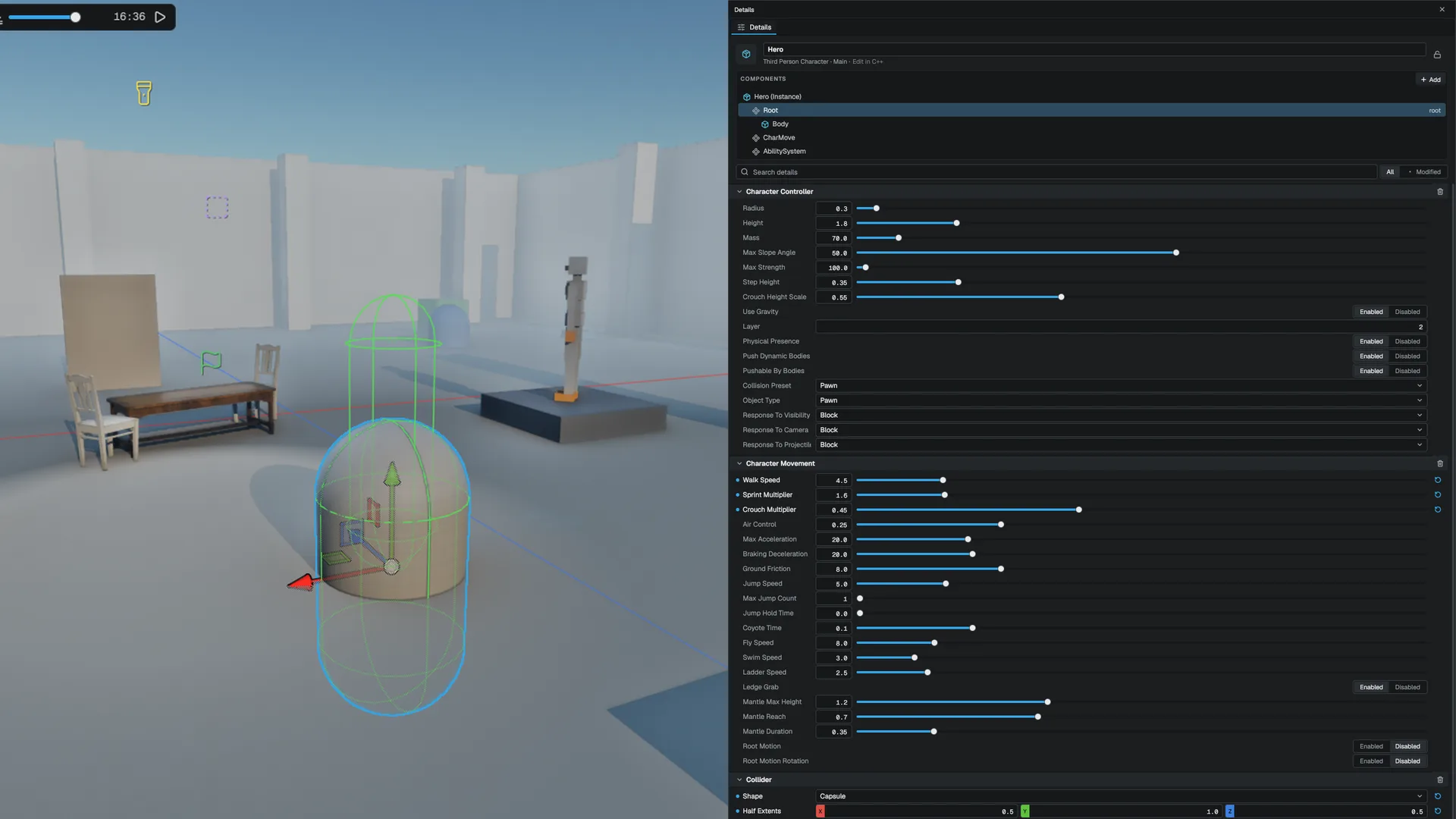
Characters do not use rigid bodies. A character controller moves a capsule with its own collision checks, and a movement component turns input into velocity through a set of movement modes. ACharacter wires both up for you; this page explains what they do and how to tune them.
The character controller
CharacterControllerComponent wraps Jolt's kinematic CharacterVirtual. CharacterControllerComponent
| Field | Effect |
|---|---|
radius, height, mass | The capsule |
maxSlopeAngle, stepHeight | The steepest walkable slope and the tallest step the capsule climbs |
stepForwardTest, stepMinForward, stepDownExtra | How far ahead of a blocked move the stair probe looks for a tread, the least the capsule must advance over a step, and extra drop allowed after the step-up |
stickToFloorDistance | How far the capsule is pulled down onto the ground when it walks off a slope or step edge; 0 lets it launch off ramps |
collideWithCharacters | Characters with this on block each other even without a physical presence (off by default; one capsule test per other such character) |
crouchHeightScale | Crouched height as a fraction of height |
pushBodies, maxStrength | Whether walking into dynamic bodies shoves them, and how hard |
physicalPresence | Builds an inner kinematic body (on by default) |
A character's position is its feet: the capsule rises from it, and a character placed with its position on the floor stands on the floor. A capsule or cylinder primitive on the character (the placeholder body of AThirdPersonCharacter and ATopDownCharacter) is drawn at the capsule's radius and height with its base on the feet, follows the capsule when you resize it, and shrinks with it on a crouch. Any other primitive is lifted so its lowest point rests on the feet. A mesh asset keeps its own pivot, so import characters with the origin between the feet, as the mannequin is. The editor's selection bounds, snap to floor and the collision view all measure the body where it is drawn. FFeetAnchoredBody
The inner body is what makes a character visible to the rest of the world: traces, overlaps, contact events, AI sight lines and the scanner hit it, and characters block each other. Without it, bullets pass straight through. The default Pawn preset blocks Visibility and ignores Camera, so AI sight stops on a player but a spring arm does not collide with its own owner.
A ray that starts inside a capsule hits it at distance 0. Every trace fired from a character must ignore that character's own body. Get it with PhysicsSystem::GetQueryBodyForEntity(entity), which returns the right body for characters and rigid bodies alike, and pass it to FQueryFilter::Ignore. PhysicsSystem::GetQueryBodyForEntity
Moving platforms
A character standing on a moving or rotating body is carried with it. linearVelocity on the component is the character's own velocity relative to the ground, so standing still on a lift reads as zero. The ground's share is in groundVelocity. When the character jumps off, it keeps the platform's velocity. CharacterController::GetLinearVelocity
A body with a ContactModifier carries the character at its Surface Velocity like a conveyor, and a One Way platform lets the character jump up through it and land on top. Mass scale is not read by characters.
Movement modes
CharacterMovementComponent holds the active EMovementMode. The movement system runs before the physics step. CharacterMovementComponent
| Mode | Entered | Behavior |
|---|---|---|
Walking | On the ground | walkSpeed, scaled by sprintMultiplier or crouchMultiplier; maxAcceleration, brakingDeceleration, groundFriction |
Falling | Automatically when the ground is lost | Gravity plus airControl steering; back to Walking on landing |
Flying | Only when gameplay sets it | flySpeed, no gravity, full 3D input |
Swimming | Automatically when chest-deep in a water volume | swimSpeed, buoyant, 3D input |
Ladder | Automatically inside a LadderVolume | Climbs along the volume's climbAxis at ladderSpeed; jump detaches |
Mantling | Jump while airborne next to a reachable ledge | Rises until the feet clear the top, then moves over it |
Custom | When gameplay sets a registered custom mode | Your own step function |
Jump tuning:
| Field | Effect |
|---|---|
jumpSpeed | Initial vertical speed |
maxJumpCount | Jumps before landing; 2 gives a double jump |
jumpHoldTime | Seconds a held jump button keeps adding lift; 0 gives a fixed-height jump |
coyoteTime | Seconds after leaving a ledge during which a jump still counts as grounded |
Ledge grabbing uses ledgeGrabEnabled, mantleMaxHeight, mantleReach and mantleDuration.
Drive a character from code
On an actor, MCharacterMovementComponent is the interface to all of this. ACharacter creates one and forwards Jump, Crouch, UnCrouch and SetSprinting to it. MCharacterMovementComponent
| Function | Effect |
|---|---|
Jump(), StopJumping() | Press and release jump |
Crouch(), UnCrouch(), IsCrouched() | Crouch, which shrinks the capsule |
SetSprinting(bool), IsSprinting() | Sprint |
SetMovementInput(dir), ClearMovementInput() | Set the input direction directly |
IsGrounded(), GetVelocity(), GetMovementModeName() | Read state |
The same functions are Visual Scripting nodes.
Root motion
When useRootMotion is set and the character's animator produces a root delta, the movement step drives the capsule from the animation instead of from input. Vertical motion stays under gravity and jumping. rootMotionRotation also applies the animation's yaw to the facing. See Animation.
Root-motion sources
A root-motion source is movement that gameplay applies over time: a dash, a knockback, a launch pad, a pull to a ledge. Because a source is a function of its own elapsed time only, client prediction and the server produce the same movement, which a velocity poked into the controller cannot. FRootMotionSource
Function on MCharacterMovementComponent | Movement |
|---|---|
ApplyDash(velocity, duration) | Constant world velocity for the duration |
ApplyJumpForce(direction, distance, height, duration) | An arc to distance that peaks at height |
ApplyMoveTo(target, duration) | Straight to a point, arriving exactly |
StopRootMotionSource(id) | Ends a source early; each Apply returns its id |
#include "Game/ACharacter.h"
#include "Game/MCharacterMovementComponent.h"
#include "Math/Vec3.h"

Mowo::ACharacter* hero = nullptr;
Mowo::MCharacterMovementComponent* movement = hero->FindComponent<Mowo::MCharacterMovementComponent>();
int32_t dash = movement->ApplyDash(Mowo::Vec3(0.0f, 0.0f, -12.0f), 0.2f);
(void)dash;
Custom movement modes
For a mode the engine does not ship, such as wall running or a grapple, register a step function under a small id and switch the character into it. The step runs in place of the built-in modes, so it is predicted and reconciled like Walking, as long as it reads only the character's own components and the time step. FCustomMovementModes
#include "ECS/World.h"
#include "Physics/Components/CharacterControllerComponent.h"
#include "Physics/Components/CharacterMovementComponent.h"
#include "Physics/CustomMovementMode.h"

static constexpr uint8_t kWallRun = 1;

static void StepWallRun(Mowo::World& world, uint64_t entityId, Mowo::CharacterMovementComponent& movement, Mowo::CharacterControllerComponent& controller, float deltaTime) {
}

void RegisterWallRun() {
	Mowo::FCustomMovementModes::Register(kWallRun, &StepWallRun, "WallRun");
}

void UnregisterWallRun() {
	Mowo::FCustomMovementModes::Unregister(kWallRun, &StepWallRun);
}
Switch a character into it with MCharacterMovementComponent::SetCustomMovementMode(1) and back with ClearCustomMovementMode(). Unregister the mode when your module shuts down, because the registry holds a plain function pointer into your module.
Related
- Gameplay framework for
ACharacterand the template characters - Physics
- Multiplayer for client prediction of character movement
- API: Physics module, Game module
Engine sources
This page describes behavior implemented in these files of the engine repository, checked against commit f8a3a28e3.
- Engine/Source/Runtime/Physics/Public/Physics/CharacterController.h
- Engine/Source/Runtime/Physics/Public/Physics/Components/CharacterControllerComponent.h
- Engine/Source/Runtime/Physics/Public/Physics/Components/CharacterMovementComponent.h
- Engine/Source/Runtime/Physics/Public/Physics/Components/LadderVolumeComponent.h
- Engine/Source/Runtime/Physics/Public/Physics/CharacterMovementSystem.h
- Engine/Source/Runtime/Physics/Public/Physics/CharacterLadderSystem.h
- Engine/Source/Runtime/Physics/Public/Physics/CustomMovementMode.h
- Engine/Source/Runtime/Physics/Public/Physics/RootMotionSource.h
- Engine/Source/Runtime/Physics/Public/Physics/PhysicsSystem.h
- Engine/Source/Runtime/Game/Public/Game/MCharacterMovementComponent.h
- Engine/Source/Runtime/Game/Public/Game/ACharacter.h
- Engine/Source/Runtime/Game/Public/Game/FeetAnchoredBody.h
- Engine/Source/Runtime/Game/Public/Water/CharacterWaterSystem.h