Your first contribution to Wolang
Wolang is open source and wants contributors, and you do not need to have written a compiler before. Here is how to build it, the four commands that tell you a change is ready, what the project values in a pull request, and a list of open tasks sorted by size, from date formatting in the standard library to alias analysis in the IR.
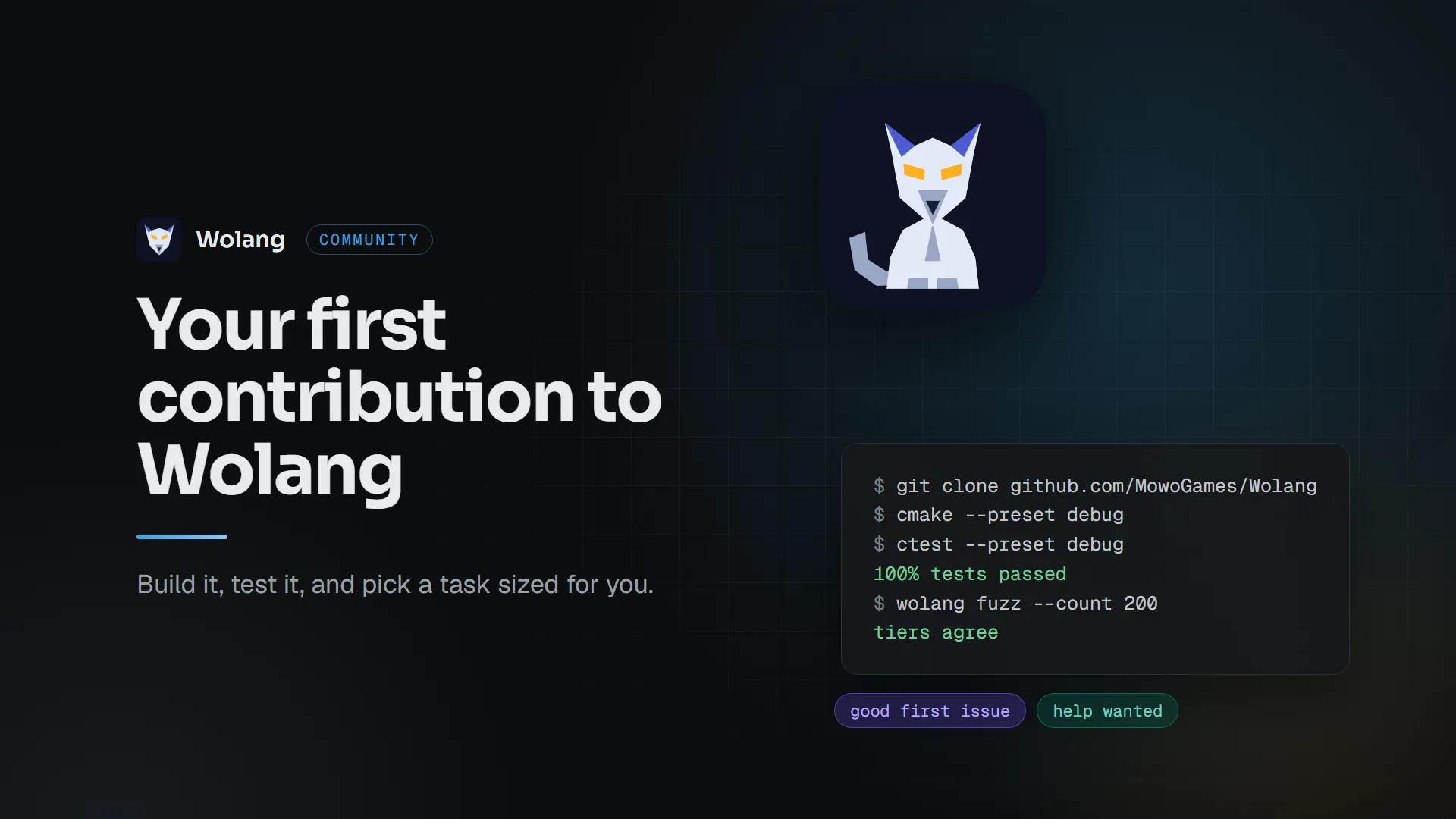
Wolang is open source and we want your help. You do not need to have written a compiler before. Much of what is open is library code written in Wolang itself, documentation, or editor support.
Build it
Wolang needs clang and CMake 3.24 or newer, and nothing else. LLVM is optional and only needed for wolang build.
git clone https://github.com/MowoGames/Wolang && cd Wolang
cmake --preset debug && cmake --build --preset debug -j
ctest --preset debug
There are presets for release, asan (address and undefined-behaviour sanitizers), windows (clang-cl) and x64. docs/building.md covers each system.
The four commands
When these are all quiet, your change is ready for a pull request:
W=build/debug/tools/wolang/wolang
ctest --preset debug
$W test lib/std && $W test lib/http && $W test lib/db
$W fuzz --count 200
$W fmt --check lib examples
The fuzzer only matters if you touched lowering, a back end or the runtime, but it is cheap to run anyway.
What a good pull request looks like
It comes with the test that would have caught it. Every fix includes a test that fails without the fix:
| What changed | Where the test goes |
|---|---|
| The compiler, a back end, the runtime | tests/unit/, as a WOLANG_TEST |
| A library written in Wolang | an @Test function in the same file |
| Something only a real program shows | an example under examples/ |
It keeps the tiers agreeing. The interpreter, the dev tier and LLVM must give the same answer. A change that makes them disagree is a bug, even if each answer looks reasonable.
It adds no dependencies. The compiler, runtime and libraries depend on clang and nothing else. If you think something needs a third-party library, ask first. The answer is sometimes yes, but never automatically.
Its comments explain why. Design decisions are numbered in docs/decisions.md, and code points at them.
Commits follow Conventional Commits: feat(std): read and write TOML, fix(lower): wrap a value returned from a fallible function.
Where to start
| Size | Area | What is missing |
|---|---|---|
| small | docs | A tour or cookbook program you wish existed. CI compiles every example, so a wrong one fails. |
| small | std |
strftime-style patterns for formatting and parsing dates. |
| small | http |
A cookie jar and multipart/form-data in the client. |
| small | editors | Support for an editor that is not in editors/ yet. |
| medium | codegen | Strength reduction for any constant divisor, not only powers of two. |
| medium | codegen | Reusing spill slots instead of one frame area per temporary. |
| medium | tools | Reading an IR dump back in. |
| medium | tools | Version ranges for dependencies. |
| deep | IR | Alias analysis, and the vectorisation that depends on it. |
| deep | codegen | Windows on arm64. |
Issues labelled good first issue are small and self-contained. Say on the issue that you are taking it so two people do not do the same work.
Not ready to write code?
That helps too:
- Write a program in Wolang and tell us what was awkward. Language feedback from real programs is worth more than any design discussion.
- Report a tier disagreement. If
wolang runandwolang run --interpretprint different things, that program is a gift. - Ask questions in Discussions. A question that is hard to answer usually means the documentation is missing something.
The ground rules
The code of conduct is short: talk about the work, not the person, and remember that most people here are not writing in their first language. Contributions are licensed under Apache-2.0, the same as the project. Vulnerabilities go through SECURITY.md, not public issues.
See you in the pull requests.